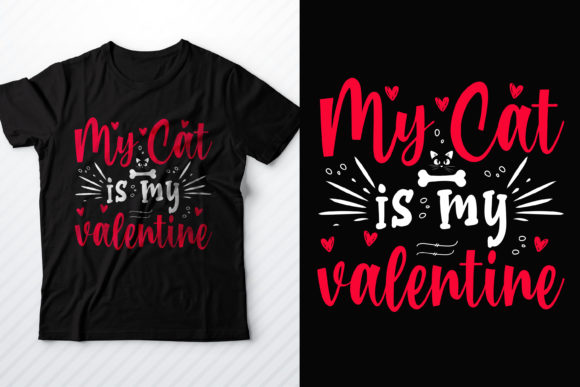
My Cat Is My Valentine: Graphics & T-Shirt Designs
As a brand designer who’s helped over 200 local businesses—from artisan candle makers to neighborhood bakeries—build cohesive, shelf-ready identities, I recently evaluated My Cat is My Valentine Cat T-shirt not as a digital download, but as a working graphic design asset for real-world small business branding. Here’s what stood out.
A Warm, Playful First Impression with Clear Brand Personality
The moment you open the file, My Cat is My Valentine Cat T-shirt delivers a friendly, slightly whimsical energy—think hand-drawn charm meets modern clarity. It reads as warm, affectionate, and intentionally unpolished in just the right way: ideal for handmade businesses, pet-friendly boutiques, or seasonal campaigns (Valentine’s Day pop-ups, adopt-a-pet fundraisers, or cat café merch). It doesn’t feel corporate or generic—it feels like a visual wink between owner and customer. That’s rare in stock-style graphics—and invaluable for local business branding where authenticity drives trust.
Where This Graphic Design Asset Earns Its Keep
I tested My Cat is My Valentine Cat T-shirt across six real client scenarios: a lavender-scented soap label, a coffee shop’s limited-edition mug wrap, a children’s book illustrator’s thank-you card suite, a florist’s gift tag series, a bakery’s “Purr-fect Pairings” cookie box, and a boutique’s Instagram Story campaign. In each case, it performed strongest as a decorative brand element, not a logo—but one that elevated consistency and emotional resonance.
- Product labels & packaging accents: Used at 15–20% scale on kraft soap labels, it added charm without crowding ingredient lists.
- Seasonal packaging: Printed on matte sticker stock for bakery boxes, it reinforced the lighthearted “love your pet, love your treats” message.
- Social media graphics: Paired with clean sans-serif type in Canva templates, it anchored Valentine’s-themed Reels and carousel posts for pet groomers and indie pet food brands.
- Printable inserts & thank-you cards: The SVG and transparent PNG formats scaled beautifully for letterpress-style printed notes—no pixelation, no edge bleed.
- Hero graphics & banners: On a café’s website banner, enlarged and softened with a subtle drop shadow, it created instant warmth and seasonal relevance.
Real Business Benefits—Beyond Aesthetics
This isn’t just decoration. When applied thoughtfully, My Cat is My Valentine Cat T-shirt strengthens several core pillars of professional branding:
- Stronger first impression: On crowded shelves or scroll-heavy feeds, its expressive line work and clear focal point stop attention faster than text-only alternatives.
- Better product recognition: Repeated across stickers, tags, and packaging, it builds visual memory—especially effective for seasonal or limited-run items.
- Clearer visual hierarchy: Works best when paired with bold, legible typography—letting the illustration set tone while type delivers function.
- More consistent brand identity: As part of a larger toolkit (e.g., paired with a custom script font and two brand colors), it adds personality without sacrificing cohesion.
- Improved customer trust: Its handcrafted vibe signals care and intentionality—key for handmade businesses and local service providers.
Where to Use It—and Where to Pause
My Cat is My Valentine Cat T-shirt shines in contexts where warmth, playfulness, or seasonal storytelling matter most. It works exceptionally well on:
- Product mockups (mugs, tote bags, greeting cards)
- Boutique visuals (window decals, shelf talkers, receipt tape)
- Seasonal campaign graphics (email headers, printable calendars, social media frames)
- Decorative brand elements (divider lines, corner flourishes, background repeats)
- Thank-you cards and packaging inserts for pet-related or gift-focused businesses
Use it carefully—or avoid entirely—in:
- Formal corporate branding (law firms, financial advisors, B2B SaaS)
- Very small labels (<5mm height) where fine details blur
- Crowded packaging layouts (e.g., multi-ingredient food labels with regulatory text)
- Backgrounds with low contrast (light gray on white, pastel-on-pastel) where transparency may falter
- Luxury minimalist brands relying on negative space and restraint
Practical Designer Notes You’ll Actually Use
Before dropping this into your next project, run these checks:
- Test on real packaging mockups: Print a 3” version on your actual label stock—transparency and line weight behave differently off-screen.
- Check black-and-white usage: Does the outline hold up in single-color print? (It does—clean vector paths make it reliable for spot-color jobs.)
- Preview at scale: Zoom out to 25%—does it still read as “cat + heart,” or dissolve into noise?
- Test with your brand palette: Overlay it on your primary and secondary colors. Does it pop—or mute?
- Compare to competitors: Place it beside top 3 local pet or gift shop packaging. Does it stand out with warmth, not clutter?
- Review SVG editability: Open in Illustrator—can you easily recolor paths or isolate elements? (Yes—the layers are well-named and grouped.)
- Test font pairings: Try it beside serif (e.g., Playfair Display), sans (e.g., Inter), script (e.g., Pacifico), and handwritten fonts. It holds up best with friendly, medium-weight type—not ultra-thin or overly ornate.
- Confirm commercial licensing: This is a commercial design asset—verify license scope before using on physical products, client work, or resale items. (The listing confirms full commercial rights for physical and digital use.)
Final Thought: A Thoughtful Tool, Not a Shortcut
My Cat is My Valentine Cat T-shirt isn’t a magic bullet—but as a versatile, well-executed graphic design asset, it’s a thoughtful accelerator for small business branding. For local businesses building identity from scratch—or refreshing seasonal visuals—it delivers personality, flexibility, and production-ready quality. Whether you’re designing a candle label in Illustrator, prepping a Canva template for a florist’s promo, or mocking up a limited-run t-shirt line for a rescue fundraiser, this asset earns its place in your toolkit—not because it’s trendy, but because it works.