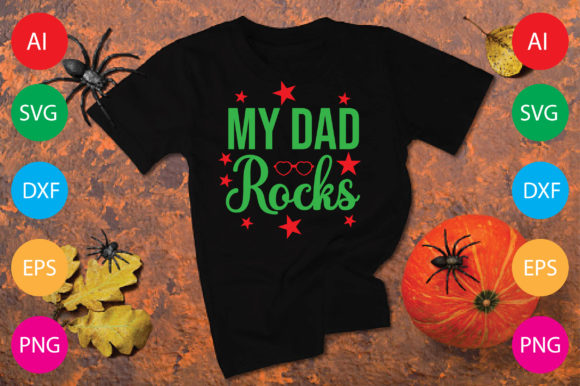
My Dad Rocks
A Designer’s Real-World Look at This Simple-but-Strong Embroidery Design
I pulled up My Dad Rocks last week while prepping a batch of custom embroidered tote bags for a local dad-themed pop-up. Not for a client—this was for my own small shop’s Father’s Day collection—and I needed something that felt warm, legible, and genuinely wearable—not cutesy, not ironic, just solid. That’s when My Dad Rocks caught my eye: clean, centered, uncluttered, with just enough personality to land without shouting.
First Impression: Friendly, Focused, and Fabric-Ready
The design reads instantly. No hidden meaning, no visual noise—just bold, rounded lettering with a subtle rock motif (a stylized guitar pick or maybe a smooth river stone? It’s open, but intentional). It’s not an applique design, nor does it rely on dense fill stitch or delicate satin stitch borders. Instead, it leans into confident outlines and moderate stroke weight—exactly what you want in a machine embroidery design meant for real-world use.
It feels like a T-Shirt Designs staple—but don’t limit it there. I immediately pictured it stitched on a midweight cotton sweatshirt cuff, heat-pressed onto a linen apron pocket, or even scaled down as a baby embroidery detail on a onesie chest. Its simplicity is its strength: it doesn’t fight the fabric, the thread, or the wearer’s expectations.
Where It Shines (and Where It Needs Thought)
My Dad Rocks works beautifully on stable, medium-weight fabrics—think structured tote bags, brushed cotton sweatshirts, tea towels, and pillow covers. On those surfaces, the letterforms hold shape, the curves stay smooth, and the overall presence feels handmade but polished. As a Graphics file set, it gives flexibility: the SVG and AI files let me tweak spacing before digitizing; the PNG and JPEG help me build fast printable mockups for Etsy listings; the DXF opens cleanly in my embroidery software for hoop alignment checks.
But here’s where experience kicks in: this isn’t a one-size-fits-all embroidery file. On thin or stretchy fabric—like lightweight jersey tees or baby rib knit—I’d add light cutaway stabilizer and consider simplifying the outer curve slightly to avoid puckering. On dark fabric, contrast matters more than usual: a bright white or heather grey thread lifts the design; charcoal or navy thread can make it disappear unless the stitch density is just right. And on curved surfaces—caps or baseball hats—I’d test-hoop first. The centered layout means less distortion risk than off-center scripts, but any lettering needs breathing room near seams and brims.
I also wouldn’t push My Dad Rocks too small. Below 3 inches wide, the subtle rock element blurs, and the letters start to feel cramped rather than friendly. For baby embroidery or tiny patches, I’d either choose a different design—or scale up and place it on a bib or blanket corner instead.
What It Adds to Your Finished Product
This is where My Dad Rocks earns its keep. It elevates a plain item without overcomplicating it. A simple canvas tote becomes a thoughtful, personalized gift—not “generic dad gear,” but something that says *I saw you, I get you*. That builds customer trust faster than clever slogans ever could.
For Etsy sellers and craft fair vendors, it’s a reliable anchor design: easy to pair with coordinating fonts or minimalist icons (a tiny hammer, a coffee cup, a camping tent), scalable across product types, and recognizable at a glance—even in thumbnail view. It supports brand consistency without demanding rigid rules. You can use it in black thread on oatmeal linen or neon pink on navy denim, and it still reads as the same warm, grounded voice.
And yes—it boosts giftability. I’ve watched customers pause at this phrase longer than at flashier designs. There’s emotional resonance in its sincerity, especially paired with quality stitching and thoughtful presentation. It doesn’t need glitter or gradients to feel special.
Practical Notes Every Embroidery Designer Should Check
- Test first—always run My Dad Rocks on scrap fabric matching your final project’s weight and texture. Note how the curves stitch, where tension pulls, and whether the edges feather.
- Review stitch density—not all versions of this design will be optimized for dense fill. If your software shows overlapping stitches in the letter interiors, reduce density slightly for breathability and wash durability.
- Confirm hoop size—the layout fits comfortably in a 4×4 hoop, but double-check your version’s bounding box before loading. Some AI or EPS exports include artboard padding that throws off placement.
- Inspect small details—zoom in on the rock motif’s endpoints and letter junctions. Are they clean? Do corners stitch crisply or blur? That tells you whether it’ll hold up after repeated washing.
- Mock it both ways—build quick black-and-white mockups to see contrast on light and dark backgrounds. What reads well on screen may vanish on fabric.
- Stabilizer choice matters—for textured fabrics like terry cloth or bouclé, use tear-away + light cutaway. For knits, go with adhesive + cutaway to prevent shifting.
- Licensing clarity—since this is a digital embroidery file, confirm whether your license covers commercial embroidery, finished product resale, or digital redistribution. When in doubt, contact the seller before listing on Etsy or bundling into craft kits.
Final Thought: A Quiet Workhorse, Not a Flashy Star
My Dad Rocks won’t win awards for complexity—but then again, neither do the best-selling items in my shop. It’s the kind of design that disappears into the product just enough to feel effortless, yet stays memorable because it’s honest and well-proportioned. It suits custom apparel, holiday embroidery, boutique branding, and heartfelt handmade products alike—not by trying to be everything, but by doing one thing really well.
If you’re building a craft business, stocking a small shop, or shipping personalized gifts with confidence, this is the kind of embroidery file that quietly earns repeat orders. Just remember: even simple designs deserve smart execution. Test it. Tune it. Trust your eye—and your stitcher’s instincts—before going live. Then let My Dad Rocks do what it does best: speak clearly, stitch cleanly, and mean something real.