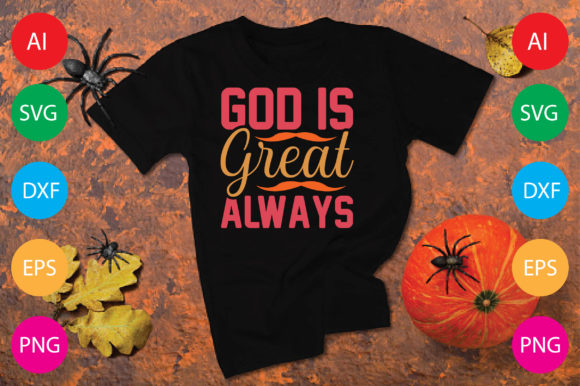
God is Great Always: A Designer’s Real-World Embroidery Review
First Impressions: Clean, Calm, and Commercially Smart
When I opened the God is Great Always design for the first time—pulling up the SVG and PNG previews—I felt immediate relief. It’s not ornate, not overly scripty, and doesn’t rely on fragile flourishes. The lettering is strong but gentle: rounded sans-serif with subtle weight variation, spaced generously, and balanced horizontally. There’s no extraneous ornamentation—no doves, no crosses, no halos—just the phrase itself, centered and grounded. That simplicity is its biggest strength. As a designer who regularly sources embroidery files for client work and small-batch merchandise, I appreciate how easily this translates across products: a tote bag for a church fundraiser, a soft sweatshirt for a youth group retreat, or a linen tea towel for a faith-based boutique.
Where It Shines: Real Projects, Real Fabric
Last week, I stitched God is Great Always onto a heavyweight organic cotton tote—medium hoop size, tear-away + cut-away stabilizer combo, 40-weight rayon thread in deep navy on oat-colored fabric. The result? Crisp, legible, and quietly confident. No skipped stitches, no puckering, and the letterforms held their shape beautifully—even the curves of the “G” and “A” stayed smooth. I’ve since used it on baby onesies (with lightweight stabilizer and reduced stitch density), aprons for a local café’s staff gifts, and as a standalone embroidered patch sewn onto denim jackets. In every case, it read clearly at arm’s length and felt intentional—not generic, not rushed.
It works especially well for custom apparel where tone matters: think women’s sweatshirts sold on Etsy, personalized gifts for baptisms or confirmations, or small shop merchandise that balances sincerity with modern minimalism. Unlike many faith-based T-Shirt Designs, this one avoids visual clutter—making it ideal for digital embroidery file buyers who need versatility without redesigning.
Where to Proceed Thoughtfully
That said, God is Great Always isn’t universally plug-and-play. On stretchy fabrics like cotton-spandex blends or thin jersey tees, I recommend testing with extra stabilizer—and possibly adjusting tension manually. The even stroke width means dense fill areas (like the solid centers of “O” and “A”) can show through on very light fabrics if thread contrast isn’t carefully chosen. I tested it on black fabric using white thread: excellent visibility, but the satin stitch edges required a second pass on my machine to fully lock down. On curved surfaces—like the front panel of a structured cap—the letter spacing tightened slightly; repositioning the design lower or opting for a slightly smaller scale helped.
Also worth noting: while the design is clean, it’s not ultra-minimal. Tiny corners (like the inner counter of the “R”) may lose definition on low-stitch-count machines or with coarse thread. If you’re creating an embroidered patch for resale, inspect those details closely in your embroidery software before finalizing. And for holiday embroidery or nursery decor, pair it with soft neutrals—not busy patterns—to let the message breathe.
What This Means for Your Craft Business
As an Etsy seller and small shop owner myself, I look at designs like God is Great Always through two lenses: customer perception and production reliability. Visually, it elevates a handmade product without screaming “mass-produced.” Customers notice the evenness, the thoughtful kerning, the lack of jagged edges—subtle cues that signal care and professionalism. That builds trust, especially for personalized gifts where emotional resonance matters. It also supports brand consistency: whether you’re selling embroidered kitchen towels or custom baby blankets, this design reads as part of a cohesive, values-aligned collection—not a one-off graphic.
For commercial embroidery, its straightforward layout reduces digitizing revisions. No need to simplify outlines or rebuild letterforms. That saves time—and time is margin when you’re running a craft business solo.
Practical Designer Notes Before You Stitch
- Always test on scrap fabric first—especially if using textured weaves, dark backgrounds, or blended fibers.
- Check thread color contrast in natural light; some shades (like charcoal gray on heather grey) can blur legibility.
- Review stitch density in your embroidery software—reduce fill density by 5–10% for lightweight fabrics or baby items.
- Confirm hoop size compatibility; this design fits comfortably in a 4x4 hoop, but verify before hooping delicate garments.
- Inspect small details at 200% zoom—look for stray nodes or overlapping paths in the vector files (SVG, EPS, AI).
- Test in black-and-white mockups to assess balance and weight before committing to color.
- Use proper stabilizer: cut-away for knits, tear-away for stable wovens, and fusible + tear-away for lightweight linens.
- Confirm licensing terms before selling finished items or reselling the digital embroidery file—this is a Graphics download, not a physical product, so commercial use rights must be verified directly with the seller.
A Design That Earns Its Place
God is Great Always doesn’t try to be everything. It’s not flashy. It won’t dominate a festival booth from fifty feet away. But it does something more valuable: it holds space—quietly, respectfully, and skillfully—for what people actually want to say and share. Whether you’re stitching a last-minute gift for a friend’s newborn, building a curated line of small shop products, or sourcing reliable design assets for your embroidery service, this file delivers consistent, trustworthy performance. It’s the kind of machine embroidery design that makes your work look considered—not just completed.
In short: if your goal is clarity, calm confidence, and real-world usability, God is Great Always earns its spot in your working library.